Tuesday, December 4, 2012

Chinese Built Ghost Town in Angola


Outside of Luanda (Angola’s Capital city), China has recently built a giant ghost town.  Known as Nova Cidade de Kilamba, it is a residential development with 12 schools, 750 apartment buildings, and over a hundred stores.  Chinese firms have constructed this 3.5 billion dollar project, and several other cities like it across Angola.  This particular city was built to house around half a million people, and covers about 12,355 acres.

The city and its complexes are very nice, especially in comparison to where the large majority of Angolan’s live, so it would appear that this project would help Angolans.  However, the GDP per capita in Angola is just over $5,000 and the apartments cost between $120,000 and $200,000 which is of course far out of the reach of most Angolans.

Why then, would the Chinese build these cities?  With Angola serving as China’s largest supplier of oil in Africa, it is likely China is investing in Angola to gain further favor with the Angolan officials and the people.  Just like the U.S. and the USSR did during the Cold War (and as the US and Russia still do in many ways to this day), China is investing in a country to help ensure a strong a economy that will further benefit them as it grows.

            I chose this article, because presented a fine example of China’s economic investments in Africa, as well as its ever growing presence on the continent.  With some of China's investments falling off (as seen in Mauritania with the railway project), and others failing, it is hard to say whether or not these new cities will have any sort of positive impact on Angola.  Judging my the mere cost of the apartment's and the limited success of similar cities in China, my vote is for no.


By: Mamta Badkar

Sierra Leone's Presidential Election


Sierra Leone’s incumbent president, Ernest Bai Koroma, of the All People’s Congress party, recently beat out nine other candidates in the presidential election. The All People’s Congress (APC) party has ruled parliament since 2007 and was formed in 1960. Officials say that the elections are becoming increasingly fair and transparent, and the nation is moving towards a more equal democracy. Sierra Leone’s elections function under the absolute majority method, so the candidate must receive 55% of the votes to win. According to BBC, the voter turnout rate was 87.3%, and Koroma claimed 58.7% of those votes. Sierra Leone has not had a peaceful independence, and the time since the 1991-2002 civil war has been tumultuous. These elections demonstrate great progress in their move towards a functioning, fair government.
            This election is particularly newsworthy because it was peaceful, which is something Sierra Leone has struggled with for years. The government of the nation has overcome great obstacles, and the violence within the election process is one of those obstacles. A peaceful election speaks volumes about the development in Sierra Leone. To be able to emerge from the civil war that killed nearly 50,000 citizens and grow into a country of peaceful and transparent elections is very big, and it goes to show how much can change in just a decade. This was the first election held without UN supervision, and they demonstrated that they are capable of instituting fair elections by themselves.
            President Koroma has taken the last five years to prove that he’s serious about development of infrastructure and international trade, and wants to continue with his efforts in his upcoming term.

Source: http://www.bbc.co.uk/news/world-africa-20472962

"Winning Ticket" in Kenya Presidential Race to Consist of ICC Charged Criminals


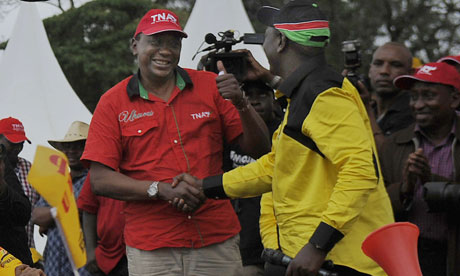
The 2007 Kenyan presidential race resulted in a violent uproar that resulted in the loss of 1,300 lives and displaced 600,000 more. The two men believed to have orchestrated this post-election violence are Deputy Prime Minister Uhuru Kenyatta and former cabinet minister William Ruto. The ICC is charging both men with crimes against humanity for their alleged involvement in organizing the violent outbreak. The men are set to appear in front of the International Criminal Court on April 10 of next year but it now appears that that might be too late. Kenyatta and Ruto announced on Sunday that they tend to run on the same ticket in next years election for the offices of President and Vice President, respectively. The election falls on March 4, just before their ICC hearing.

The dangerous men have a wide range of charges brought against them from the ICC including murder, rape, deportation, persecution, and various other crimes against humanity. However, they maintain their innocence and stress their desire to “preach peace” and “build Kenya.” It seems as though many Kenyans are willing to accept this ticket. The petition to seek a court ruling on their eligibility to run has been unexpectedly withdrawn leaving little to impede their campaign before March 4.  With Kenyatta coming from the largest ethnic group in Kenya and Ruto from the third largest tribe, the men are projected to garner mass support by combining their ticket. A win in the election will surely help their case the following month with the ICC.

The 2007 violence changed the image we had as an international audience of Kenya as a stable East African country. Since then, the country has experienced turmoil and tension due to the worst violence it had seen in years and the subsequent unresolved issues. I think it is very unfortunate that two men suspected to have been behind the devastation could potentially be rightfully elected into the highest political positions in the country. The biggest shame, to me, is the withdrawal of the petition to seek a ruling on their eligibility in the first place. It seems to me that two men who are being charged with various heinous crimes by the ICC would be ineligible to run for the presidency. And the fishiness of them running on the same ticket should raise a few eyebrows as well. Since the election falls before their ICC hearing I think it is very important that they are brought before some type of higher court to decide whether or not they should be allowed to run. The idea that they would win because of their ethnic background, which would in turn affect the outcome of the ICC’s decision, is disturbing. I hope that they are held to a higher standard of accountability for their actions before the election so as to shed some light on the potential corruption of their ticket.

http://www.aljazeera.com/news/africa/2012/12/201212293351420258.html

Monday, December 3, 2012

Africa Becoming The New China?

     Economic analysts have concluded that the economic environment in Africa today is largely similar to that of China thirty years ago. China has of course recognized this due to their heavy investments in the economies of nearly every African nation, spending as much as over three hundred million in countries such as Sudan. The African economy resembles China in the past with factors such as a large workforce, economies ripe for diversification, large amounts of untilled arable land, and heaps of natural resources ready to be used for manufacturing. China is investing largely in African infrastructure to get the economies of Africa bumping. China invests in construction projects across the continent that benefit not only Africa, but also the Chinese investors. China is also developing a tourist relationship with Africa, many flights operate between Beijing and Nairobi daily. China was at one time in a vulnerable economic position similar to Africa before it experienced heavy investment from the United States and Europe. Because of this unique experience, the Chinese government and investors know how to play the African market to not only benefit Africa, but to benefit themselves as well.

     I chose this issue because I find it interesting that many African nations have the start up economy similarities that China once experienced. China has since then worked itself up to becoming one of the strongest economies in the world, nearly rivaling that of the United States. It makes me optimistic of Africa, because if China did it, there is no reason for at least some of Africa’s nations to experience similar growth and development.

 Works Cited 

 Burger, Schalk. "Africa the China of 30 years ago, analyst argues ." engineering news. N.p., 23 Nov. 2012. Web. 3 Dec. 2012.

Sunday, December 2, 2012

Chinese vs. African, Conflict of Interests


          China has done much good in Africa. Through direct investment, they have enabled many African countries to improve their infrastructure. Chinese companies have extracted raw materials from the resource rich Africans and provided jobs to locals. However, it is becoming increasingly clear that many aspects of Chinese influence aren’t all they’re cracked out to be, and the struggle between Chinese and African interests is becoming ever more evident.
            On August 4th, workers in a Zambian coalmine killed their Chinese supervisor, running him over with a mining cart, over a misunderstanding regarding minimum wage laws (Wonacott).  At the same mine in 2010, 13 workers were shot by Chinese managers over a similar dispute (Wonacott). African countries continue to raise minimum wages and increase regulations on largely Chinese operated industries. Many Chinese businessmen argue that it is becoming more and more expensive to operate in Africa. Instead of abiding by local laws, Corporations ignore many of the regulations in place (Moore). Union leaders are often given brides, as too are the local bureaucrats who are supposed to be enforcing those laws. The Chinese are also notorious for the cheap means of production. Recently, a Chinese made hospital in Nigeria was abandoned after cracks in the wall formed (Moore). The quantity over quality approach of the Chinese may not necessarily be beneficial to the people of Africa. Chinese influence in Africa is encouraging corruption and business malpractice, which have plagued Africa since the days of colonialism (Moore). 
            I chose to write about this topic because of the conflict of interest between Chinese businesses and African countries. The Chinese are trying to get as much money out of Africa as possible, which wouldn't be so bad if they were also abiding by the local laws and regulations. However, African countries well intentioned means of creating a better life for their people often end up creating the opposite. Africa cannot improve their economy significantly without help from the outside, but they shouldn't do so by undermining their sovereignty. If Africa truly wants change, it can't look past companies that largely ignore their laws and buy out the local bureaucrats. This is more of the same old approach that has hindered Africa for generations.
Works Cited
Moore, M. "Trying to Pull Together." The Economist. The Economist Newspaper, 20 Apr. 2011. Web. 02 Dec. 2012. <http://www.economist.com/node/18586448>.
Wonacott, Peter. "Chinese Investment Brings Jobs, Conflict to Zambia Mines." Online.wsj.com. Wall Street Journal, 5 Sept. 2012. Web. 2 Dec. 2012. <http://online.wsj.com/article/SB10000872396390444082904577609161447720808.html>.

Saturday, December 1, 2012

Chinese Investments Benefit Africa


Chinese Investment in Africa


     With China's recent economic surge, the African continent has reaped the benefits of China's increasing demands.  As shown in the picture above, almost every country in Africa has experienced interests from China, those who are rich in natural resources have seen a huge demand from the economic superpower and for those who are not as blessed, have benefited from trading and investment opportunities from Chinese companies. China has seen Africa as a huge opportunity and market where it's needs for infrastructure such as roads, schools, computer networks, telecom systems and power generation has attracted many Chinese firms. What gives China an advantage over it's western counterparts is that it offers a "no-strings"aid policy and do not mix economic interests with human rights, political or economic issues. Another benefit African countries provide is that they are able to keep costs down and though they hire a lot of local workers with low wages, the extra benefit is that these workers are able to learn new skills because of the Chinese funded work. What has also been frequently seen in Africa, is that along with many of it's many projects such as mining extraction, they also tend to build a lot of the infrastructure that comes with the business such as railroads and roads. China's economic attaché in Ethiopia explains that China's policy is that "it never imposes its own will on African countries, nor interferes in the domestic affairs of African countries".


    The reason I've chosen this article and to speak on this subject is that we are seeing a new approach and economic relationship growing in the region and it will be important to keep an eye on how it develops further. Most people outside of Africa do not see it as having a huge market potential, rather a burden with aid flow being dumped into the region. Also previously, Western countries and International organizations such as the IMF and World Bank, when investing in Africa  placed a ton of austerity measures which has often placed huge economic burdens on the continent when they were meant to help the continent. These burdens have resulted in talks of debt relief and forgiveness since they have placed many countries on a crutch. I believe with China's economic growth has come as a relief to African countries and has had huge benefits to both countries with the building of infrastructure and huge gains of capital while China has been able gain access to many of the metals and energy needed to power its population of a billion people. Though critics have said that China's disregard of human rights and political situations in the African countries when it comes to economic matters will in turn prolong conflicts and turmoil (such as its huge investments in Sudan), i would reply that these were still prevalent before the influx of Chinese investments, and in fact in the long term, with the building of infrastructure and education of the local people, conflicts and democracy will follower quicker than if there was no capital or infrastructure building. It has come to a point where African countries are asking for more Chinese development and are concerned for it's economic well being since it is directly tied with the demands of Africa natural resources. The U.S. and the west have not taken advantage of Africa's opportunities and at this point i do not think U.S. firms can compete with China's firms due to political and economic externalities. 


"African Countries Demanding More from Chinese Investment." Mining Weekly. N.p., n.d. Web. 11 Nov. 2012. <http://www.miningweekly.com/article/african-countries-demanding-more-from-chinese-investment-2012-11-02>.

"China in Africa: Developing Ties." BBC News. BBC, 26 Nov. 2007. Web. 11 Nov. 2012. <http://news.bbc.co.uk/2/hi/africa/7086777.stm>.

"Chinese Slow down Would Hurt African Growth." Brisbane Times. N.p., n.d. Web. 11 Nov. 2012. <http://www.brisbanetimes.com.au/business/china/chinese-slow-down-would-hurt-african-growth-20121110-294d8.html>.


NGOs react to possible EU aid cuts

In an article written November 21st from The Parliament, entitled "NGOs appeal to EU leaders to scupper Van Rompuy's 'aid cuts'" author Martin Banks elaborates on the recent event. A few weeks ago, in the EU budget proposals for 2014-2020, council president Herman Van Rompuy took the brunt of lash backs from numerous NGOs due to his proposal that included drastic cuts from the EU's aid for development and development projects. If the EU accepts his proposals, NGOs claim that current countries receiving aid from the EU will feel brutal effects from the cuts. According to the article, Van Rompuy proposed to cut 3.335 billion Euros from the development fund-this cut would be taking away 11% of the aid fund, and most directly effecting intended funding and aid for sub-Saharan Africa development and projects.

NGOs have not kept silent in their response to the proposal. In fact, around 2000 European based NGOs protested these cuts in a letter to the powerhouse countries of the EU, declaring there is no good reason to cut these funds as it only costs citizens around 1.87 Euros a month to save millions of lives. 
The letter pleas for the EU to fulfill their commitments of aid funds they once promised. Directors of widely known NGOs such as ONE are personally speaking out against the cuts, claiming they would only setback development and cost lives of those underdeveloped. 

As we have been learning in class, foreign aid is a highly debated topic: how should it be channeled, and is it truly effective? Without any profound conclusions, I believe that aid works best when aid funds are in the hands of NGOs. Thus, these European NGOs working in areas such as sub-Saharan Africa can focus on smaller specific projects opposed to big ideas. In the article, it's conveyed that European NGOs receive money from the EU. If aid was cut off to these organizations, would projects and further development in sub-Saharan Africa come to a halt, as advocates propose? It is hard to know for certain, as we see aid incredibly difficult to measure its impact and evidence of helping growth. However, since in this instance aid is not directly channeled from government to government, rather through the role of an NGO in Africa and other impoverished areas, I side with the NGOs in opposition to Van Rompuy's aid cuts to the EU development budget with optimistic hopes if aid continues it will be spent with intelligence.

NGOs appeal to EU leaders to scupper Van Rompuy's 'aid cuts'

Article: 
The Parliament November 21st, 2012.
http://www.theparliament.com/latest-news/article/newsarticle/ngos-appeal-to-eu-leaders-to-scupper-van-rompuys-aid-cuts/#.ULkfoKXA_ao